Texas Roadhouse Sirloin vs Ribeye vs Filet: Which Is Best in 2026?
Choosing a steak at Texas Roadhouse can be harder than it looks. The menu includes several popular cuts, but three names appear again and again when diners compare flavor, calories, protein, portion size, and overall nutrition: Sirloin, Ft. Worth Ribeye, and Dallas Filet.
So which one should you order?
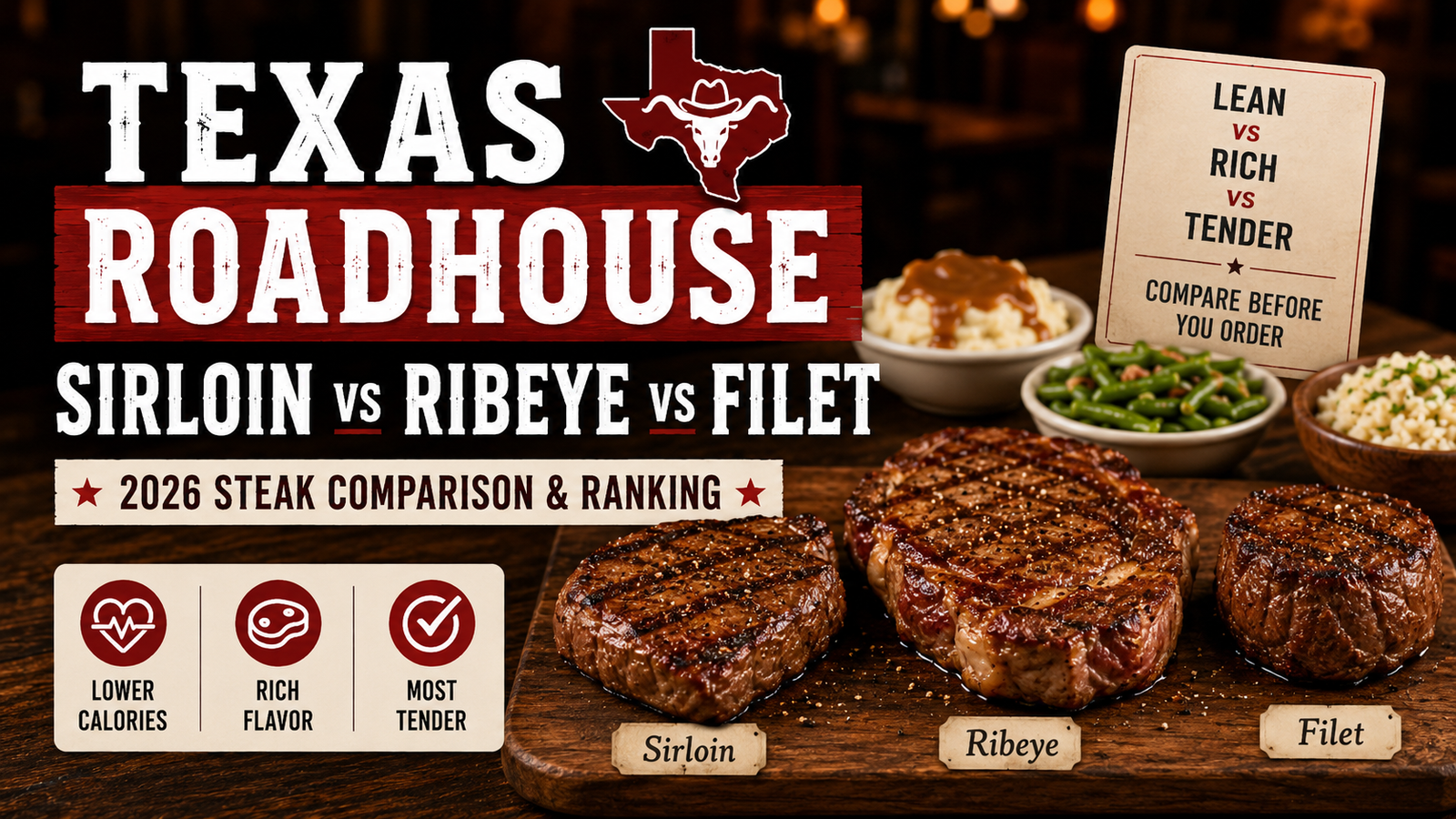
This Texas Roadhouse Sirloin vs Ribeye vs Filet comparison breaks down the major differences between these popular steaks in 2026. Instead of simply declaring one steak the winner, we compare them for different goals—including lower calories, higher protein, lower fat, tenderness, richer flavor, portion control, and overall nutrition.
Texas Roadhouse currently lists Hand-Cut Sirloin, Dallas Filet, and Ft. Worth Ribeye among its core Hand-Cut Steaks. The restaurant describes the Sirloin as lean and juicy, the Dallas Filet as its most tender steak, and the Ft. Worth Ribeye as particularly juicy and flavorful because of its marbling.
That means each steak serves a different type of diner.
If calories are your priority, the Sirloin may stand out. If tenderness matters most, the Dallas Filet has an advantage. If you want a richer steakhouse flavor and do not mind significantly more fat and calories, the Ribeye may be the more satisfying choice.
Let’s compare them directly.
Quick Answer: Sirloin vs Ribeye vs Filet
For readers who want the answer immediately:
Best for lower calories: USDA Choice Sirloin
Best for protein per calorie: USDA Choice Sirloin
Best for tenderness: Dallas Filet
Best for rich steak flavor: Ft. Worth Ribeye
Best for lower fat: USDA Choice Sirloin
Best middle-ground choice: Dallas Filet
Best for a large, indulgent steak: Ft. Worth Ribeye
The nutrition information currently listed in our Texas Roadhouse nutrition database shows substantial differences between the cuts.
| Steak | Calories | Fat | Carbs | Protein | Sodium |
|---|---|---|---|---|---|
| USDA Choice Sirloin – 6 oz | 250 | 6 g | 3 g | 46 g | 560 mg |
| Dallas Filet – 6 oz | 270 | 10 g | 6 g | 45 g | 720 mg |
| Dallas Filet – 8 oz | 360 | 13 g | 8 g | 60 g | 960 mg |
| Ft. Worth Ribeye – 12 oz | 960 | 72 g | 12 g | 78 g | 1,180 mg |
| Ft. Worth Ribeye – 14 oz | 1,120 | 84 g | 14 g | 90 g | 1,370 mg |
| Ft. Worth Ribeye – 16 oz | 1,280 | 96 g | 16 g | 103 g | 1,570 mg |
These figures apply to the steak item itself in the nutrition data and should not be confused with the complete meal after sides, rolls, sauces, toppings, or drinks are added.
Texas Roadhouse Sirloin vs Ribeye vs Filet: Overall Ranking
If we rank the three steaks purely from a nutrition-focused perspective, our order is:
1. USDA Choice Sirloin — Best Overall Nutrition Value
The Sirloin offers an unusually strong combination of protein and relatively low calories and fat.
A 6 oz portion provides approximately:
- 250 calories
- 6 grams fat
- 46 grams protein
- 3 grams carbohydrates
- 560 mg sodium
That means nearly 46 grams of protein for only 250 calories.
2. Dallas Filet — Best Balance of Tenderness and Nutrition
The Dallas Filet provides a much leaner profile than the Ribeye while delivering the tenderness many steak lovers want.
The 6 oz Filet contains approximately 270 calories and 45 grams of protein, while the 8 oz version contains about 360 calories and 60 grams of protein.
3. Ft. Worth Ribeye — Best for Flavor, Highest in Calories
The Ribeye is the richer option.
Texas Roadhouse itself emphasizes the Ribeye’s marbling, which is responsible for much of the steak’s flavor and juiciness.
That marbling also contributes a considerable amount of fat.
The 12 oz Ft. Worth Ribeye contains around 960 calories and 72 grams of fat, dramatically more than the smaller Sirloin and Filet options.
This does not make it a “bad” steak. It simply serves a different purpose.
What Is the Texas Roadhouse USDA Choice Sirloin?
The Hand-Cut Sirloin is one of the restaurant’s signature steaks.
Texas Roadhouse describes it as a lean, juicy steak offered at a strong value.
It is also particularly important to the chain: Texas Roadhouse’s March 2026 company fact sheet says its 6-ounce USDA Choice Sirloin is its number-one seller.
That makes sense when you look at the nutrition.
Sirloin Nutrition by Size
| Sirloin Size | Calories | Fat | Protein | Sodium |
|---|---|---|---|---|
| 6 oz | 250 | 6 g | 46 g | 560 mg |
| 8 oz | 340 | 8 g | 61 g | 740 mg |
| 11 oz | 460 | 11 g | 84 g | 1,020 mg |
| 16 oz | 670 | 16 g | 122 g | 1,490 mg |
Nutrition figures are from the current table on our site.
Even the 16 oz Sirloin is listed at fewer calories than the 12 oz Ribeye.
That demonstrates how much steak cut and fat content can matter—not simply portion weight.
Why Sirloin Wins for Protein per Calorie
One of the most interesting parts of the Texas Roadhouse Sirloin vs Ribeye vs Filet comparison is protein efficiency.
The 6 oz Sirloin has:
46 g protein ÷ 250 calories
That works out to roughly 18.4 grams of protein per 100 calories.
The 6 oz Dallas Filet provides:
45 g protein ÷ 270 calories
or roughly 16.7 grams per 100 calories.
The 12 oz Ribeye provides:
78 g protein ÷ 960 calories
or about 8.1 grams per 100 calories.
That means the Sirloin delivers more than twice as much protein per calorie as the 12 oz Ribeye based on these listed values.
For someone prioritizing protein without wanting an extremely calorie-dense meal, that is a meaningful difference.
What Is the Dallas Filet?
Texas Roadhouse describes the Dallas Filet as its most tender steak, noting that it is lean and has a melt-in-your-mouth texture.
Tenderness is the Dallas Filet’s main competitive advantage.
A steak can be relatively lean but still feel luxurious if its texture is exceptionally tender.
Dallas Filet Nutrition
The current nutrition information lists:
| Dallas Filet | Calories | Fat | Protein | Sodium |
|---|---|---|---|---|
| 6 oz | 270 | 10 g | 45 g | 720 mg |
| 8 oz | 360 | 13 g | 60 g | 960 mg |
The Filet is therefore only slightly higher in calories than an equivalent 6 oz Sirloin.
That makes the decision between the two much closer than the comparison with Ribeye.
Sirloin vs Filet: Which Is Better?
The answer depends on what “better” means to you.
Sirloin Wins for Calories
6 oz Sirloin: 250 calories
6 oz Dallas Filet: 270 calories
The difference is only 20 calories, so it is relatively small.
Sirloin Wins for Fat
The 6 oz Sirloin contains about 6 grams of fat, compared with 10 grams in the 6 oz Filet.
Sirloin Slightly Wins for Protein
6 oz Sirloin: 46 g protein
6 oz Filet: 45 g protein
The difference is essentially negligible from a practical perspective.
Filet Wins for Tenderness
This is where the Dallas Filet separates itself.
Texas Roadhouse specifically markets it as its most tender steak.
If you dislike chewing a firmer steak and want a soft, tender texture, the Filet may easily justify the slightly higher fat and calorie count.
Sirloin Wins for Sodium
6 oz Sirloin: 560 mg sodium
6 oz Dallas Filet: 720 mg sodium.
For diners comparing sodium, the Sirloin has another advantage.
Sirloin vs Filet Winner
Nutrition winner: Sirloin
Tenderness winner: Dallas Filet
Best overall for calorie-conscious diners: Sirloin
Best overall for diners prioritizing texture: Dallas Filet
What Is the Ft. Worth Ribeye?
The Ft. Worth Ribeye represents the richer side of the steak menu.
Texas Roadhouse describes it as juicy and flavorful because of the marbling throughout the steak.
Marbling refers to fat distributed within the muscle.
That fat contributes flavor and moisture during cooking, which is one reason Ribeye is so popular among steak enthusiasts.
But fat is also calorie-dense.
That is immediately visible in the Ribeye nutrition numbers.
Ft. Worth Ribeye Nutrition by Size
| Ribeye | Calories | Fat | Sat. Fat | Protein | Sodium |
|---|---|---|---|---|---|
| 12 oz | 960 | 72 g | 30 g | 78 g | 1,180 mg |
| 14 oz | 1,120 | 84 g | 35 g | 90 g | 1,370 mg |
| 16 oz | 1,280 | 96 g | 40 g | 103 g | 1,570 mg |
Compare that with a 16 oz Sirloin:
670 calories, 16 g fat and 122 g protein.
The Sirloin is actually a larger protein source while remaining dramatically lower in total fat according to the nutrition table.
Sirloin vs Ribeye: Which Is Better?
This is probably the most dramatic comparison.
Sirloin Is Much Lower in Calories
6 oz Sirloin: 250 calories.
12 oz Ribeye: 960 calories.
The Ribeye portion is twice as large by weight, but its calorie count is nearly four times higher.
Even comparing larger portions makes the difference clear.
16 oz Sirloin: 670 calories
16 oz Ribeye: 1,280 calories
That is a difference of approximately 610 calories for steaks of the same listed weight.
Sirloin Is Much Lower in Fat
16 oz Sirloin: 16 g fat
16 oz Ribeye: 96 g fat
The Ribeye contains around six times as much total fat based on the current nutrition data.
Sirloin Provides More Protein at 16 oz
16 oz Sirloin: 122 g protein
16 oz Ribeye: 103 g protein.
Ribeye Wins for Richness
Nutrition numbers cannot measure taste preference.
For many steak lovers, Ribeye’s marbling is precisely why they choose it.
If you want a deeply rich, juicy steak and calorie or fat intake is not your main consideration, Ribeye may be the more satisfying choice.
Ribeye vs Filet: Which Is Better?
These steaks offer almost opposite experiences.
The Dallas Filet is leaner and designed around tenderness.
The Ribeye uses more marbling to create richness and flavor.
Calories
8 oz Dallas Filet: 360 calories
12 oz Ft. Worth Ribeye: 960 calories.
Although the portions are not the same size, the Filet is clearly the lighter option among standard menu offerings.
Fat
8 oz Filet: 13 g
12 oz Ribeye: 72 g.
Again, the difference is substantial.
Protein
8 oz Filet: 60 g
12 oz Ribeye: 78 g.
The Ribeye contains more total protein, but it requires far more calories to provide it.
Texture
Filet wins for tenderness.
Richness
Ribeye wins for stronger beefy richness and marbling.
Best Steak for Lowest Calories
Winner: 6 oz USDA Choice Sirloin
At approximately 250 calories, the 6 oz Sirloin is difficult to beat among these three cuts.
The 6 oz Dallas Filet is close at 270 calories.
If you are selecting purely by calorie count, either can be practical compared with a Ribeye.
Best Steak for High Protein
There are two ways to answer this.
If you simply want the largest total amount of protein, larger steaks naturally provide more.
The 16 oz Sirloin contains about 122 grams of protein, while the 16 oz Ribeye contains around 103 grams.
If you want high protein without consuming a huge number of calories, the Sirloin is also the better choice.
Winner: Sirloin
Best Steak for Lower Fat
This category is straightforward.
The 6 oz Sirloin contains approximately 6 grams of total fat, compared with 10 grams for the 6 oz Filet and dramatically higher totals for Ribeye.
Winner: Sirloin
Best Steak for Lower Sodium
Among comparable smaller choices:
6 oz Sirloin: 560 mg
6 oz Filet: 720 mg
12 oz Ribeye: 1,180 mg.
Winner: Sirloin
Keep in mind that steak seasoning and restaurant preparation contribute to sodium, and modifications may differ by location.
Best Steak for Tenderness
Winner: Dallas Filet
This is not merely our ranking. Texas Roadhouse itself identifies the Dallas Filet as its most tender steak.
If texture matters more than maximizing protein per calorie, Dallas Filet may be the most enjoyable option.
Best Steak for Flavor
This category is subjective.
However, the Ribeye’s greater marbling generally creates a richer experience, and Texas Roadhouse specifically describes the Ft. Worth Ribeye as juicy and flavorful because of that marbling.
Winner for rich flavor: Ft. Worth Ribeye
Someone who prefers a leaner, cleaner beef flavor could still prefer Sirloin.
Best Steak for Portion Control
The 6 oz Sirloin and 6 oz Dallas Filet both make portion control easier than a 12–16 oz Ribeye.
Between the two, Sirloin delivers slightly more protein while containing fewer calories and less fat.
Winner: 6 oz Sirloin
Best Texas Roadhouse Steak for a High-Protein Meal
Suppose your main goal is to get substantial protein while keeping the rest of your meal manageable.
A 6 oz Sirloin + vegetable side + House Salad provides a very different nutrition profile from a 16 oz Ribeye with fries.
The steak itself is only one part of the meal.
The official menu confirms that steaks are generally served with a choice of two sides, and current side selections include Green Beans, Steamed Vegetables, House Salad, baked potato, sweet potato, fries, seasoned rice, mashed potatoes and macaroni and cheese.
That makes side selection important.
Side Choices Can Completely Change the Ranking
Imagine that you choose the 250-calorie Sirloin.
Our current nutrition calculator lists:
- Green Beans: about 100 calories
- Fresh Vegetables: about 190 calories
- House Side Salad: about 230 calories
- Mashed Potatoes: about 260 calories
- Seasoned Rice: about 360 calories
- Steak Fries: about 360 calories
- Sweet Potato: about 350 calories.
So even after choosing a relatively lean steak, your total can rise substantially depending on the sides.
The biggest takeaway is that Texas Roadhouse Sirloin vs Ribeye vs Filet should be evaluated as the starting point of your meal—not the complete meal.
What About Texas Roadhouse Rolls?
Fresh-baked bread is one of Texas Roadhouse’s signature items.
Our current calculator lists Fresh-Baked Bread at about 200 calories per listed serving, with 28 grams of carbohydrates and 5 grams of protein.
Multiple servings plus butter can therefore narrow the calorie advantage you gained by choosing a smaller steak.
If you are using the Sirloin specifically because you want a lower-calorie meal, count the bread as part of that meal.
Sirloin vs Ribeye vs Filet for Low-Carb Eating
All three are relatively low in carbohydrate compared with pasta, breaded chicken, sandwiches, and many appetizers.
However, the nutrition table does show small carbohydrate values that may reflect seasoning or preparation.
The steak itself is not usually the main carbohydrate source.
Sides, bread, sauces, sweet drinks, appetizers, and desserts are much more likely to drive the meal’s carbohydrate total.
For a lower-carb order, pair the steak with vegetable-oriented sides and check sauces or toppings separately.
Which Steak Should You Choose for Weight Management?
Weight-management needs are individual, but calories can still be compared objectively.
If you want a satisfying protein serving while leaving room for sides, the 6 oz Sirloin or 6 oz Dallas Filet gives you much more flexibility than a large Ribeye.
A 12 oz Ribeye starts around 960 calories before the rest of the meal.
By contrast, a 6 oz Sirloin begins around 250 calories.
That leaves a large difference for whatever sides, bread, drinks, or dessert you choose.
Which Steak Is Best for Muscle-Building Meals?
Protein matters for muscle-building diets, but simply ordering the largest steak is not automatically necessary.
The Sirloin is particularly impressive because of its protein-to-calorie ratio.
Examples:
6 oz Sirloin — 46 g protein / 250 calories
8 oz Sirloin — 61 g / 340 calories
11 oz Sirloin — 84 g / 460 calories
16 oz Sirloin — 122 g / 670 calories.
For diners trying to increase protein while controlling total calories, Sirloin again ranks first among these three cuts.
When Ribeye May Still Be the Better Choice
Nutrition rankings do not mean everyone should always order Sirloin.
Choose Ribeye when:
- Rich flavor matters more than minimizing calories.
- You particularly enjoy marbled steak.
- You intentionally want a larger meal.
- Your overall diet allows room for a higher-fat steak.
- Ribeye is the food you actually want and you prefer controlling portions elsewhere.
A nutrition comparison should help you make an informed choice, not turn food into a pass-or-fail test.
When Dallas Filet Is the Better Choice
Choose Dallas Filet when:
- Tenderness is your number-one priority.
- You want a relatively lean steak.
- You want something richer in experience than Sirloin but much lighter than Ribeye.
- You prefer a 6 oz or 8 oz portion.
- You dislike heavily marbled steak.
The Dallas Filet is arguably the strongest compromise of the three.
When Sirloin Is the Better Choice
Choose Sirloin when:
- Calories matter.
- You want high protein.
- You want less fat.
- You want a smaller portion.
- You are comparing sodium.
- You want flexibility for sides.
- You want the strongest protein-per-calorie ratio.
It is also worth remembering that the 6 oz Sirloin is Texas Roadhouse’s number-one-selling item according to the company’s 2026 fact sheet.
Final Ranking: Texas Roadhouse Sirloin vs Ribeye vs Filet
Here is our final comparison:
| Category | Winner |
|---|---|
| Lowest Calories | Sirloin |
| Lowest Fat | Sirloin |
| Best Protein per Calorie | Sirloin |
| Lowest Sodium | Sirloin |
| Best for Portion Control | Sirloin |
| Most Tender | Dallas Filet |
| Best Balanced Premium Choice | Dallas Filet |
| Richest Flavor | Ft. Worth Ribeye |
| Most Marbling | Ft. Worth Ribeye |
| Best for an Indulgent Steak Meal | Ft. Worth Ribeye |
Overall Winner: USDA Choice Sirloin
From a nutrition-comparison perspective, the USDA Choice Sirloin wins.
It delivers substantial protein with dramatically fewer calories and less fat than the Ribeye while remaining very close to the Dallas Filet in calories and protein.
Best Premium Alternative: Dallas Filet
The Dallas Filet takes second place because it combines high protein, moderate calories, and exceptional tenderness.
Best Flavor-First Choice: Ft. Worth Ribeye
For someone who values rich flavor and juiciness above calorie efficiency, the Ribeye remains difficult to beat.
Frequently Asked Questions
Which is healthier at Texas Roadhouse, Sirloin or Ribeye?
Based on calories, total fat and protein efficiency, the Sirloin has a substantially lighter nutrition profile. The 6 oz Sirloin is listed at approximately 250 calories and 6 grams of fat, while the 12 oz Ft. Worth Ribeye is around 960 calories and 72 grams of fat.
Is Texas Roadhouse Filet healthier than Ribeye?
The Dallas Filet is considerably lower in calories and fat than the standard Ft. Worth Ribeye portions in the current nutrition data. An 8 oz Filet contains around 360 calories and 13 grams of fat.
Which Texas Roadhouse steak has the most protein?
Among the portions compared here, the 16 oz Sirloin provides approximately 122 grams of protein. The Porterhouse T-Bone is another very high-protein option, listed at approximately 139 grams, while the Bone-In Ribeye is listed around 143 grams.
Which Texas Roadhouse steak is lowest in calories?
Among the core steaks compared here, the 6 oz USDA Choice Sirloin is listed at approximately 250 calories, followed closely by the 6 oz Dallas Filet at approximately 270 calories.
Which is more tender, Sirloin or Filet?
The Dallas Filet wins. Texas Roadhouse describes it as its most tender steak.
Which has more flavor, Ribeye or Filet?
Flavor is subjective, but Ribeye generally delivers a richer experience because of its greater marbling. Texas Roadhouse specifically highlights the Ft. Worth Ribeye’s marbling as the reason for its juiciness and flavor.
Is the 6 oz Sirloin enough protein?
The current nutrition table lists approximately 46 grams of protein in the 6 oz USDA Choice Sirloin.
Does Texas Roadhouse steak come with sides?
Yes. The official menu lists its major hand-cut steak entrées with side choices. Available sides currently include baked potato, sweet potato, steak fries, mashed potatoes, green beans, seasoned corn, macaroni and cheese, salads, rice, vegetables and other options.
Do sides count in the steak calorie figures?
The steak values compared in this article should be treated as the listed steak-item nutrition, not as the complete meal with two sides, rolls, butter, sauces, drinks or desserts.
What is the best Texas Roadhouse steak overall?
For nutrition, we rank the Sirloin first. For tenderness, Dallas Filet wins. For rich flavor and marbling, Ft. Worth Ribeye wins. The right choice therefore depends on what you want from the meal.
Final Thoughts
The Texas Roadhouse Sirloin vs Ribeye vs Filet comparison does not produce one winner for every diner.
The USDA Choice Sirloin is the clear choice when your priorities are calories, total fat, protein efficiency and portion flexibility.
The Dallas Filet is an excellent middle ground, giving you a tender steak with much more manageable calories and fat than Ribeye.
The Ft. Worth Ribeye is the flavor-first choice. It carries substantially more calories and fat, but its marbling gives it the rich steakhouse character many diners specifically want.
Before ordering, use the Texas Roadhouse Nutrition Calculator to add your steak, sides, bread and other foods together. Your complete meal matters more than any one entrée.
Texas Roadhouse’s official current menu confirms all three cuts remain part of its core steak lineup, while the company’s 2026 fact sheet identifies the 6 oz Sirloin as its top seller.